Case Study


Developing Intrapreneurial Mindset
Priyanka’s keynote during one of the CXO forums, themed “Leadership Branding – Establishing a Business Case & Talent Imperatives,” caught the attention of leaders of one of the potential clients. The VP – Engineering of the stated client organization was particularly keen to understand the dimensions of leadership development that could be deployed for her India Leadership team, comprising of Directors to accelerate leadership capability enhancement, specially against backdrop of a recent merger which had shifted the internal organizational and interpersonal dynamics across various levels and regions.
Priyanka led the effort to propose an “Intrapreneurial Leadership Development” program for the said client. In doing so, she connected with multiple stakeholders of the organization, such as the VP – Engineering and the Global leadership team, who would be the key sponsors of the program. It was during this process of pre-diagnostics that Priyanka realized the magnitude of challenges the client faced. The client had several pressing challenges, such as the lackadaisical attitude of the cohort in piloting and championing artificial intelligence (AI) COEs from India, interpersonal relationships that were conflicted, a lack of investment in people capability, mistrust, a cynical attitude, and an overall misalignment with global prerogatives. The issues highlighted couldn’t be solved through a day or two-long training program but needed a long-term leadership development intervention to bring about a transformation in the mindset, attitude, and capabilities of the cohort.
Priyanka, therefore, successfully established a business case for an Intrapreneurial Leadership development program with global leaders of the organization, with clear articulation of the expected outcomes and “Return on Equity”. She proposed a Learning & Development consultative approach with principals of “Design Thinking” to solution for client’s challenges. Eventually, her proposal on “Developing an Intrapreneurial Mindset” for the said cohort was accepted, and the program received the necessary sponsorship from global headquarters. To execute the program, she assembled and led a best-in- class team comprising an Advisor who was a veteran leader from a leading retail giant (Global Capability Centre) and brought GCC rich experiences, stories and frameworks in his arsenal, and a project leader with in depth experience of content research and instructional design. With the said team, Priyanka embarked on a bespoke engagement with the client, diagnosing, designing, and delivering a ten-month immersive journey for the cohort through a high-touch engagement, which has created a tangible impact for the client, and cohort.
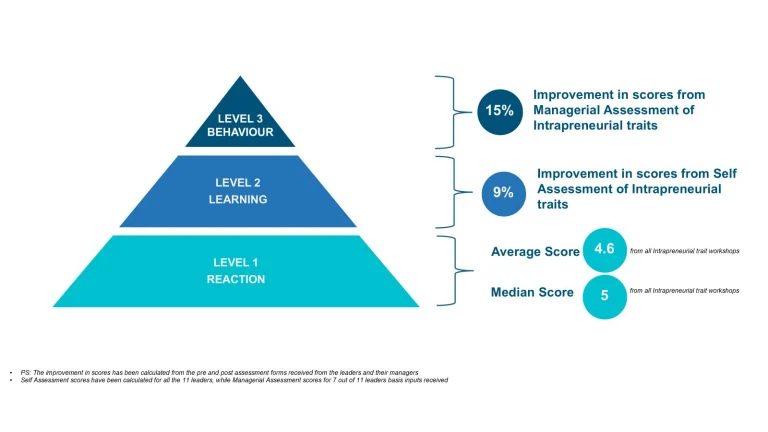
A standout feature of this program was its rigorous evaluation approach. Unlike many organizations that only measure learner reaction, Priyanka employed Kirkpatrick’s Model to assess the program’s effectiveness across three levels: Reaction, Learning, and Behavior. This method evaluated participants’ self-assessed skill index before and after the sessions, providing a comprehensive measure of their growth.
By September 2024, this leadership development program had successfully:
Empowered the cohort to transform into High-Potential Leaders:
The program enabled leaders to take initiative, pitch strategic ideas, and elevate the credibility of the India center within the client’s global operations. Additionally, the camaraderie in the group and spirit of collaboration solidified progressively, with leaders leveraging peer learning circles internally.
Enhanced Organizational and Leadership Brand
Enhanced Organizational and Leadership Brand: Through cohorts’ advocacy of the program based on perceived individual impact, the organizational and personal brands of leaders were favorably enhanced. LinkedIn posts on Shark Tank activity, Plutchik’s model of Emotional Intelligence, and Art activity on Talent strategy received 10,000+ impressions and phenomenal engagement from peer leaders of other organizations, causing a multiplier effect on the client’s external visibility as an organization that invests in its top leadership talent.
Fostered a Culture of Intrapreneurship:
Leaders were equipped to proactively contribute to the organization’s growth by cultivating innovative thinking and ownership.
Strengthened the Leadership Pipeline by 1.3 X:
Through talent mapping, high-potential leaders who demonstrated capability for taking on higher roles within the global organization were identified. These leaders were now ready with the necessary mindset, skills, and confidence to drive change and make a global impact.