

Beyond FOMO and FOBO: Choosing with Confidence
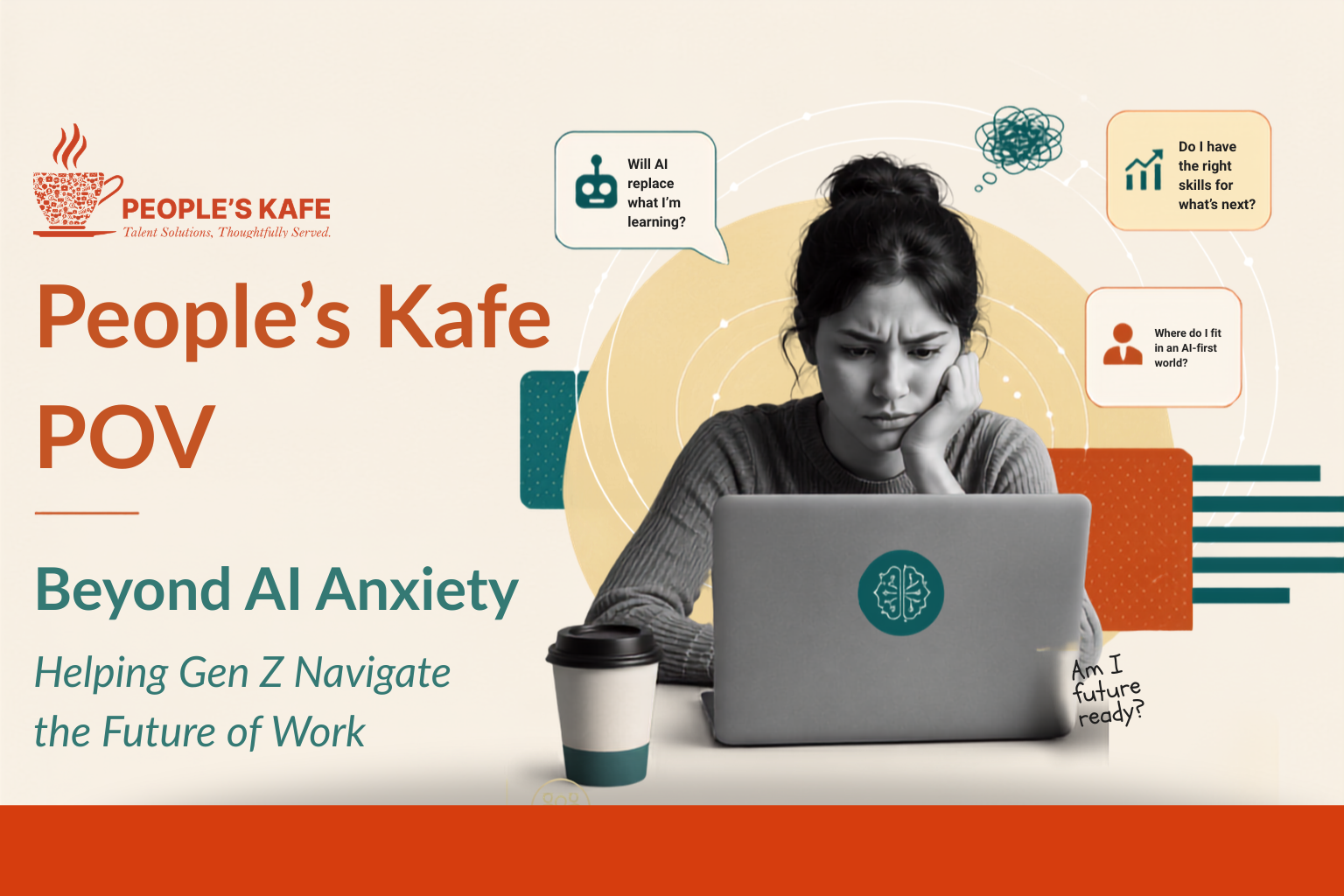
A recent People’s Kafe poll on AI anxiety highlighted that 67% of organizations are running structured AI upskilling for new hires, while 33% are having open conversations. None of the organizations reported it being off their radar. This aligns with the question that People’s Kafe post on the shift from FOMO to FOBO left hanging: does this hold up in India, specifically inside the GCCs that now do the bulk of the country’s white collar hiring? The answer is-yes, it does. And the numbers behind it are worth walking through in some detail.
India’s GCC sector has crossed ¹2,100 centres and ²2.3 million employees, making it the single largest white collar employer category in the country. Early career hires still make up close to ³30% of new intake. That scale matters here. Whatever anxiety shows up around AI in this segment isn’t confined to a few engineering campuses, it’s happening inside the biggest employer group in the country.
The pace might not be helping either. ⁴58% of Indian GCCs are already putting real money into agentic AI. ⁵83% are scaling generative AI projects, not just piloting them, but scaling them. That’s a fast-moving target for anyone trying to figure out where they fit.
And people are reacting to it. Marsh’s 2026 India People Risk report found that 43% of HR and Risk leaders now flag employee fear of job loss or change fatigue as a growing concern, and close to half, 49%, admitted their own organization is putting money into AI without putting a matching amount into training people to use it well.
Here’s the part that’s genuinely interesting though. ⁶81% of Indian GCCs say they already run internal GenAI upskilling programs. So, on paper, most of the industry is doing exactly what you’d expect a responsible employer to do. Yet the anxiety numbers don’t seem to be moving.
Why not?
Because training and reassurance solve two different problems, and most companies might be only solving one of them. A GenAI workshop may teach someone how to use a new tool but it says nothing about whether a role like theirs will exist in two years or what the path from junior to senior actually looks like now that a lot of the tasks that used to justify a junior hire are automated. Employees aren’t really asking “how do I learn this.” What they’re actually asking, in different words, is whether there’s still a way in.
That’s not just a feeling. Executives inside GCCs are openly saying that the old zero to two year hiring band is shrinking. Reduces mass hiring, more internship-based models and a general assumption that new hires should arrive more job ready than before. The entry point is changing shape and most companies might not have explained that shift clearly to the people trying to walk through it.
So, what should organizations actually be doing, beyond running more training?
• Communicate what the career path looks like ( and move beyond the training calendar). Be specific about the next couple of years, including where headcount will tighten and where it won’t, to give talent the much needed clarity. A vague promise that “people will be reskilled” may erode trust faster than an honest, even unwelcome, answer.
• Redesign entry-level roles around AI from the start. New hires may spend time building judgment and review skills by checking the AI’s output, catching its mistakes, and deciding when to trust it and when not to
• Put managers in-charge of this conversation. Most employees may process this kind of uncertainty through whoever they report to, not through a town hall or an email from HR. Companies may train frontline managers specifically on how to have these conversations, separate from training them on the tools themselves.
• Don’t treat this as just an HR problem but as a joint HR and Risk one. Marsh’s research shows that organizations where HR and Risk work together may report better outcomes across nearly every people-risk metric, AI readiness included. Sentiment data, skills-gap analysis, and workforce risk modelling may need to sit at the same table.
• While training may build skills, specificity might build trust. Most GCCs in India might have plenty of the first but not nearly enough of the second, and the anxiety data is the proof of it. The organizations that get ahead of this might not be the ones with the most training hours logged but the ones honest enough to tell early career employees, in plain language, what the way in actually looks like right now.
(Source: ¹,²,³ Nasscom-Zinnov, GCC Landscape Report 2026, ⁴,⁵,⁶EY, GCC Pulse Survey 2025)